
Text: Luke 12:15; Philippians 4:11–13; 1 Timothy 6:6–8
Opening Reflection
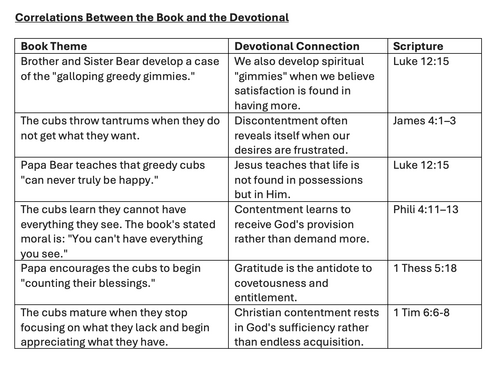
Recently, I read The Berenstain Bears, “Get the Gimmies” with my children. It is a simple story meant to help kids recognize greed and the constant desire for more. Brother and Sister Bear want more toys, more treats, more everything. Nothing seems enough.
But what struck me was not the children in the story.
It was me.
Page after page felt like a mirror I did not expect to be looking into.
Because the truth is uncomfortable:
The “gimmies” are not a childhood problem.
They are a human problem.
And if we are honest, they are a discipleship problem.
We live in a world that constantly catechizes us:
You need more.
You deserve more.
You are behind.
You are missing out.
You are one step away from peace—if you just get more.
But Scripture names this differently: covetousness, disordered desire, misplaced trust.
As I read, I realized:
I have the gimmies.
Not for toys—but for comfort, control, affirmation, and ease. And my lack of gratitude often reveals something deeper: I have not always been satisfied in Christ.
The Savior was not exposing this to condemn me.
He was exposing it to heal me.
The Biblical Diagnosis
Jesus warns:
“Take care, and be on your guard against all covetousness, for one's life does not consist in the abundance of his possessions.”— Luke 12:15
Life is not found in accumulation.
Yet we are constantly tempted to live as if it is.
Paul offers a different way:
“I have learned in whatever situation I am to be content.”— Philippians 4:11
Contentment is not instinctive.
It is learned.
The gimmies come naturally.
Contentment does not.
Paul continues:
“I can do all things through him who strengthens me.” — Philippians 4:13
In context, this is not about achievement.
It is about sufficiency.
Christ strengthens us not only to endure hardship, but to remain satisfied in Him in every circumstance—whether in plenty or in need.
Learning Contentment
Jeremiah Burroughs described Christian contentment this way:
“That sweet, inward, quiet, gracious frame of spirit, which freely submits to and delights in God's wise and fatherly disposal in every condition.”
This is not resignation.
It is trust.
It is believing that God’s wisdom is better than our desires, His provision better than our demands, and His presence more satisfying than what we lack.
The gimmies say:
“I will be satisfied when I get more.”
Contentment says:
“I have Christ, and He is enough.”
The Deep Human Problem
Blaise Pascal observed:
“What else does this craving, and this helplessness, proclaim but that there was once in man a true happiness… now lost?”
Our cravings are not random.
They are signals.
We are trying to recover fullness in everything except God.
We often mistake spiritual hunger for material need.
So we chase comfort, success, approval, control—only to find they cannot hold the weight of our longing.
Gratitude: The Antidote
If the gimmies are fueled by discontentment, gratitude is one of God’s primary means of healing the heart.
The thankful heart sees what the demanding heart misses.
The gimmies focus on what is absent.
Gratitude recognizes what God has already given.
Corrie ten Boom and her sister Betsie discovered this in Ravensbrück concentration camp. They were forced into barracks infested with fleas. Betsie insisted they thank God even for them.
Later they learned the guards avoided those barracks because of the infestation. This allowed them to hold Bible studies and encourage other prisoners freely.
What looked like a curse became a channel for gospel work.
The gimmies ask:
“What more do I want?”
Gratitude asks:
“What has God already done?”
The Gospel Solution: A Greater Affection
Thomas Chalmers wrote:
“The heart is never to be done away with its old affection by a mere act of resignation… it must be dispossessed by the inrush of a new one.”
The answer to the gimmies is not simply self-denial.
It is replacement.
Christ does not merely tell us to want less.
He gives us Himself so we can want rightly.
A Life of Dependence: George Müller
George Müller lived this reality through radical dependence on God.
He cared for thousands of orphans without ever asking people for financial support—only God in prayer.
He once wrote:
“The beginning of anxiety is the end of faith, and the beginning of true faith is the end of anxiety.”
Müller’s life was not marked by striving for more.
It was marked by trusting God for enough.
His testimony was simple but profound:
God is sufficient.
The Gospel Center
Paul summarizes the heart of it all:
“Godliness with contentment is great gain.” — 1 Timothy 6:6
Because:
“Though he was rich, yet for your sake he became poor, so that you by his poverty might become rich.” — 2 Corinthians 8:9
Jesus did not resist the gimmies.
He reversed them.
He gave up everything so that we might receive everything in Him.
The gospel is not:
“Try harder to be content.”
The gospel is:
“Look at Christ until your desires are reshaped.”
Closing Reflection
Reading The Berenstain Bears Get the Gimmies with children, I expected a simple moral lesson.
Instead, I encountered a spiritual diagnosis.
I saw how easily the gimmies still live in adult hearts—mine included.
Yet what Christ exposes, He also heals.
He meets discontentment with Himself.
He meets striving with His sufficiency.
He meets our endless desire for more with the reminder that in Him we already have the greatest treasure.
The answer to the gimmies is not minimalism.
It is not guilt.
It is not willpower.
The answer is Jesus.
Thomas Chalmers reminds us that old affections are displaced by a greater one. As Christ becomes more beautiful, lesser things lose their grip.
This is why Paul can say:
“Godliness with contentment is great gain.” — 1 Timothy 6:6
Contentment is not settling for less.
It is discovering that Christ is enough.
And when Christ is enough:
We are free.
Free from comparison.
Free from striving.
Free from the pressure of always needing more.
Free to worship.
Free to serve.
Free to give.
Free to live on mission.
The gimmies ask:
“What more can I get?”
The gospel asks:
“What more do I need when I have Christ?”
May God form in us hearts that rest in His provision, trust His goodness, and delight in His sufficiency.
And may our lives increasingly declare the truth the world needs to see:
He is enough.
Spiritual Formation Questions
Where are the “gimmies” shaping my desires or decisions right now?
What gifts from God have I stopped noticing or thanking Him for?
Where am I looking for satisfaction outside of Christ?
What would it look like this week to live as though Christ is truly enough?
What step of obedience is God inviting me into today?
Works Cited
The Berenstain Bears Get the Gimmies. New York: Random House, 1988.
Jeremiah Burroughs. The Rare Jewel of Christian Contentment. Edinburgh: Banner of Truth Trust, 1964.
Thomas Chalmers. The Expulsive Power of a New Affection. Carlisle, PA: Banner of Truth Trust, 1960.
Blaise Pascal. Pensées. Translated by A. J. Krailsheimer. London: Penguin Classics, 1995.
George Müller. The Autobiography of George Müller. Uhrichsville, OH: Barbour Publishing, 1996.
Corrie ten Boom. The Hiding Place. Grand Rapids, MI: Chosen Books, 1971.
The Holy Bible, English Standard Version. Wheaton, IL: Crossway, 2016.
Opening Reflection
Recently, I read The Berenstain Bears, “Get the Gimmies” with my children. It is a simple story meant to help kids recognize greed and the constant desire for more. Brother and Sister Bear want more toys, more treats, more everything. Nothing seems enough.
But what struck me was not the children in the story.
It was me.
Page after page felt like a mirror I did not expect to be looking into.
Because the truth is uncomfortable:
The “gimmies” are not a childhood problem.
They are a human problem.
And if we are honest, they are a discipleship problem.
We live in a world that constantly catechizes us:
You need more.
You deserve more.
You are behind.
You are missing out.
You are one step away from peace—if you just get more.
But Scripture names this differently: covetousness, disordered desire, misplaced trust.
As I read, I realized:
I have the gimmies.
Not for toys—but for comfort, control, affirmation, and ease. And my lack of gratitude often reveals something deeper: I have not always been satisfied in Christ.
The Savior was not exposing this to condemn me.
He was exposing it to heal me.
The Biblical Diagnosis
Jesus warns:
“Take care, and be on your guard against all covetousness, for one's life does not consist in the abundance of his possessions.”— Luke 12:15
Life is not found in accumulation.
Yet we are constantly tempted to live as if it is.
Paul offers a different way:
“I have learned in whatever situation I am to be content.”— Philippians 4:11
Contentment is not instinctive.
It is learned.
The gimmies come naturally.
Contentment does not.
Paul continues:
“I can do all things through him who strengthens me.” — Philippians 4:13
In context, this is not about achievement.
It is about sufficiency.
Christ strengthens us not only to endure hardship, but to remain satisfied in Him in every circumstance—whether in plenty or in need.
Learning Contentment
Jeremiah Burroughs described Christian contentment this way:
“That sweet, inward, quiet, gracious frame of spirit, which freely submits to and delights in God's wise and fatherly disposal in every condition.”
This is not resignation.
It is trust.
It is believing that God’s wisdom is better than our desires, His provision better than our demands, and His presence more satisfying than what we lack.
The gimmies say:
“I will be satisfied when I get more.”
Contentment says:
“I have Christ, and He is enough.”
The Deep Human Problem
Blaise Pascal observed:
“What else does this craving, and this helplessness, proclaim but that there was once in man a true happiness… now lost?”
Our cravings are not random.
They are signals.
We are trying to recover fullness in everything except God.
We often mistake spiritual hunger for material need.
So we chase comfort, success, approval, control—only to find they cannot hold the weight of our longing.
Gratitude: The Antidote
If the gimmies are fueled by discontentment, gratitude is one of God’s primary means of healing the heart.
The thankful heart sees what the demanding heart misses.
The gimmies focus on what is absent.
Gratitude recognizes what God has already given.
Corrie ten Boom and her sister Betsie discovered this in Ravensbrück concentration camp. They were forced into barracks infested with fleas. Betsie insisted they thank God even for them.
Later they learned the guards avoided those barracks because of the infestation. This allowed them to hold Bible studies and encourage other prisoners freely.
What looked like a curse became a channel for gospel work.
The gimmies ask:
“What more do I want?”
Gratitude asks:
“What has God already done?”
The Gospel Solution: A Greater Affection
Thomas Chalmers wrote:
“The heart is never to be done away with its old affection by a mere act of resignation… it must be dispossessed by the inrush of a new one.”
The answer to the gimmies is not simply self-denial.
It is replacement.
Christ does not merely tell us to want less.
He gives us Himself so we can want rightly.
A Life of Dependence: George Müller
George Müller lived this reality through radical dependence on God.
He cared for thousands of orphans without ever asking people for financial support—only God in prayer.
He once wrote:
“The beginning of anxiety is the end of faith, and the beginning of true faith is the end of anxiety.”
Müller’s life was not marked by striving for more.
It was marked by trusting God for enough.
His testimony was simple but profound:
God is sufficient.
The Gospel Center
Paul summarizes the heart of it all:
“Godliness with contentment is great gain.” — 1 Timothy 6:6
Because:
“Though he was rich, yet for your sake he became poor, so that you by his poverty might become rich.” — 2 Corinthians 8:9
Jesus did not resist the gimmies.
He reversed them.
He gave up everything so that we might receive everything in Him.
The gospel is not:
“Try harder to be content.”
The gospel is:
“Look at Christ until your desires are reshaped.”
Closing Reflection
Reading The Berenstain Bears Get the Gimmies with children, I expected a simple moral lesson.
Instead, I encountered a spiritual diagnosis.
I saw how easily the gimmies still live in adult hearts—mine included.
Yet what Christ exposes, He also heals.
He meets discontentment with Himself.
He meets striving with His sufficiency.
He meets our endless desire for more with the reminder that in Him we already have the greatest treasure.
The answer to the gimmies is not minimalism.
It is not guilt.
It is not willpower.
The answer is Jesus.
Thomas Chalmers reminds us that old affections are displaced by a greater one. As Christ becomes more beautiful, lesser things lose their grip.
This is why Paul can say:
“Godliness with contentment is great gain.” — 1 Timothy 6:6
Contentment is not settling for less.
It is discovering that Christ is enough.
And when Christ is enough:
We are free.
Free from comparison.
Free from striving.
Free from the pressure of always needing more.
Free to worship.
Free to serve.
Free to give.
Free to live on mission.
The gimmies ask:
“What more can I get?”
The gospel asks:
“What more do I need when I have Christ?”
May God form in us hearts that rest in His provision, trust His goodness, and delight in His sufficiency.
And may our lives increasingly declare the truth the world needs to see:
He is enough.
Spiritual Formation Questions
Where are the “gimmies” shaping my desires or decisions right now?
What gifts from God have I stopped noticing or thanking Him for?
Where am I looking for satisfaction outside of Christ?
What would it look like this week to live as though Christ is truly enough?
What step of obedience is God inviting me into today?
Works Cited
The Berenstain Bears Get the Gimmies. New York: Random House, 1988.
Jeremiah Burroughs. The Rare Jewel of Christian Contentment. Edinburgh: Banner of Truth Trust, 1964.
Thomas Chalmers. The Expulsive Power of a New Affection. Carlisle, PA: Banner of Truth Trust, 1960.
Blaise Pascal. Pensées. Translated by A. J. Krailsheimer. London: Penguin Classics, 1995.
George Müller. The Autobiography of George Müller. Uhrichsville, OH: Barbour Publishing, 1996.
Corrie ten Boom. The Hiding Place. Grand Rapids, MI: Chosen Books, 1971.
The Holy Bible, English Standard Version. Wheaton, IL: Crossway, 2016.
Posted in Bill Wills
Recent
Archive
2026
2025
June
July
December
2024
July
September
October
2023
April
May
December
2022
April
August
December
2021
January
March
September
November
Categories
no categories